


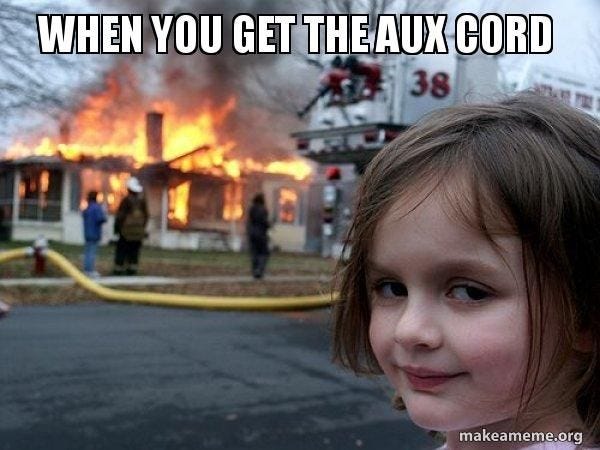
Lord knows no anxiety like being handed the aux cord in an Uber full of your most musically opinionated friends.
Fifteen seconds to prove you understand where the night is going without trying too hard to prove it. Silent judgment radiating from the backseat as you desperately scroll. Your thumb hovering over three songs, second-guessing ‘em all. Too safe and you’re boring. Too weird and you’re auditioning. Too obvious and everyone’s disappointed. Performance anxiety distilled into a lightning cable.
It’s ridiculous that any of this matters. But it absolutely does.
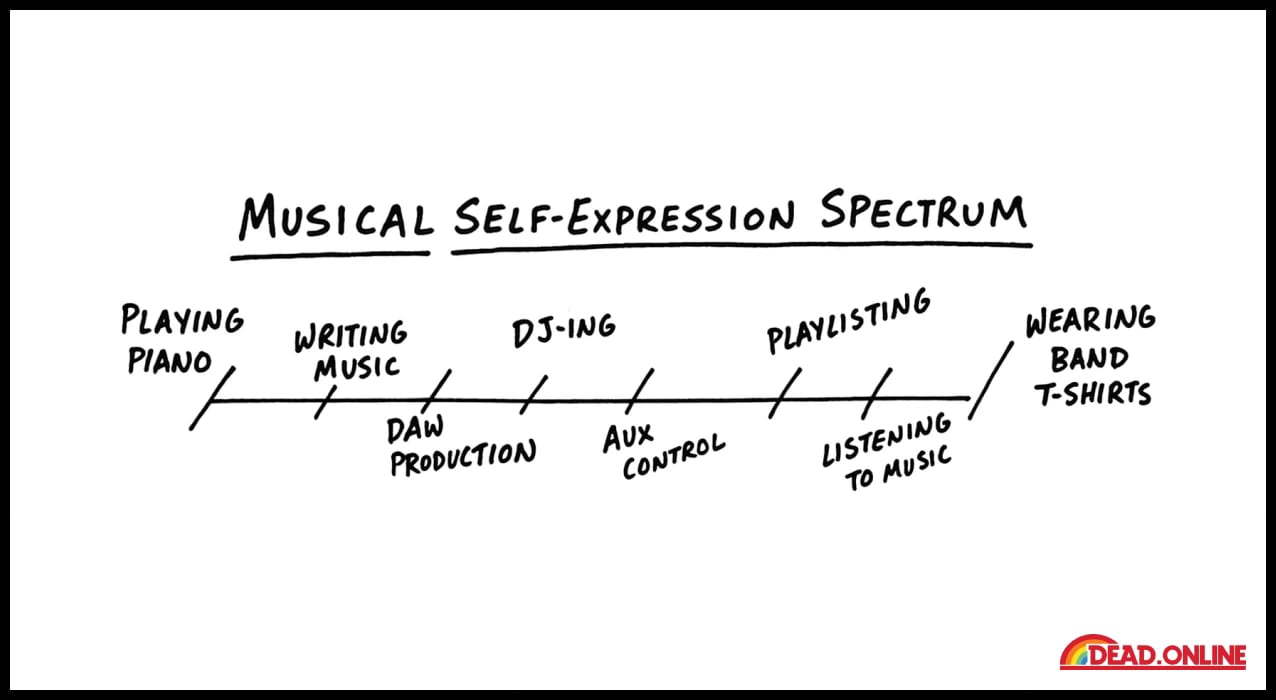
Choosing a song on the aux cord is musical self-expression. You didn’t make the track. You didn’t perform it. But you chose it. And that counts. That’s “music.”
Aux cord DJ’ing (and that tinge of anxiety) says something we usually don’t say out loud: music isn’t just the thing you make or the thing you play. Music is the full spectrum of ways you show up around sound.
Playing piano is music. Writing music is music. But so is ripping Shania Twain on the jukebox at a dive, building a playlist for The High Road to Taos, wearing a band t-shirt you bought at Sasquatch! decades ago because the cotton still tastes like sunscreen.
Wherever you are, you’re on the Musical Self-Expression Spectrum.
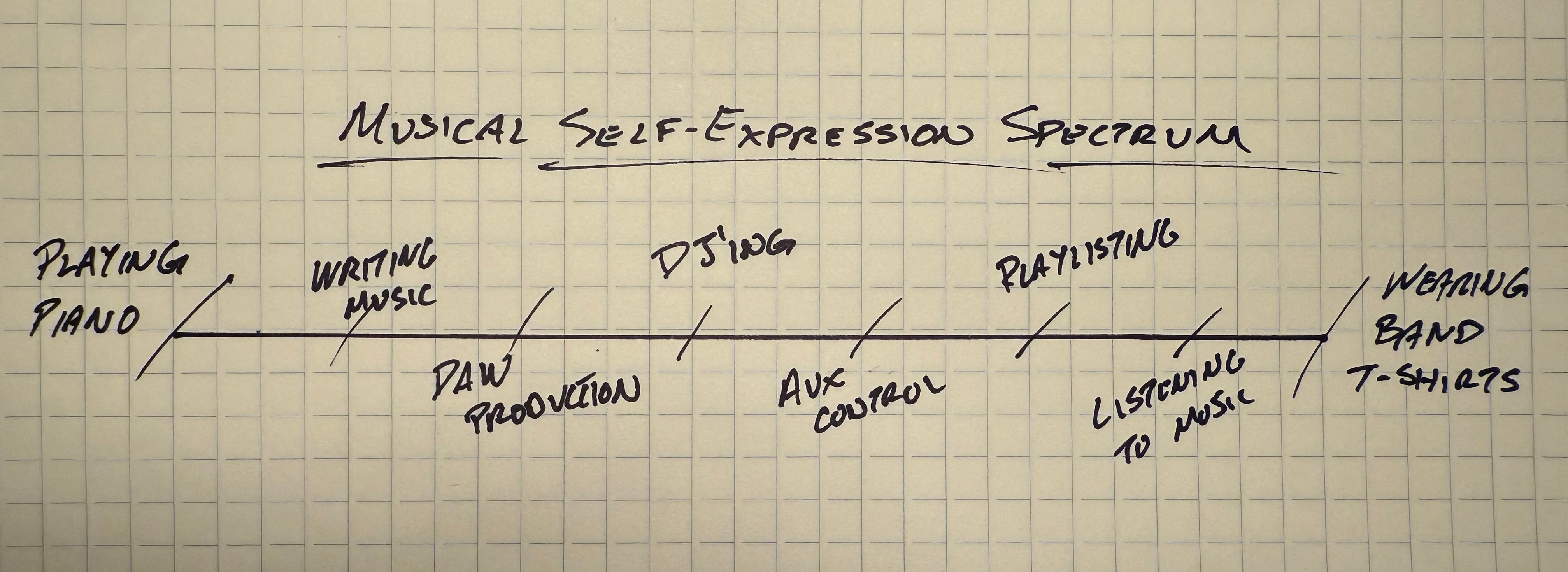
It’s not hierarchical. Playing guitar isn’t “better” than producing on Ableton, which isn’t any “better” than curating a Heated Rivalry playlist on Spotify.
I’ve surfed this Spectrum my entire life. I play the piano. And the drums, sort of. I build music products. And, yes, I playlist. And produce. And sort of DJ. And music blog (also, sort of?).
They’re all just different modes of participating in the same larger thing. Different ways of musicking.
“Musicking”
Christopher Small gave us Musicking in ‘98. Music isn’t a thing. It’s a doing.
Music is a verb, not a noun.
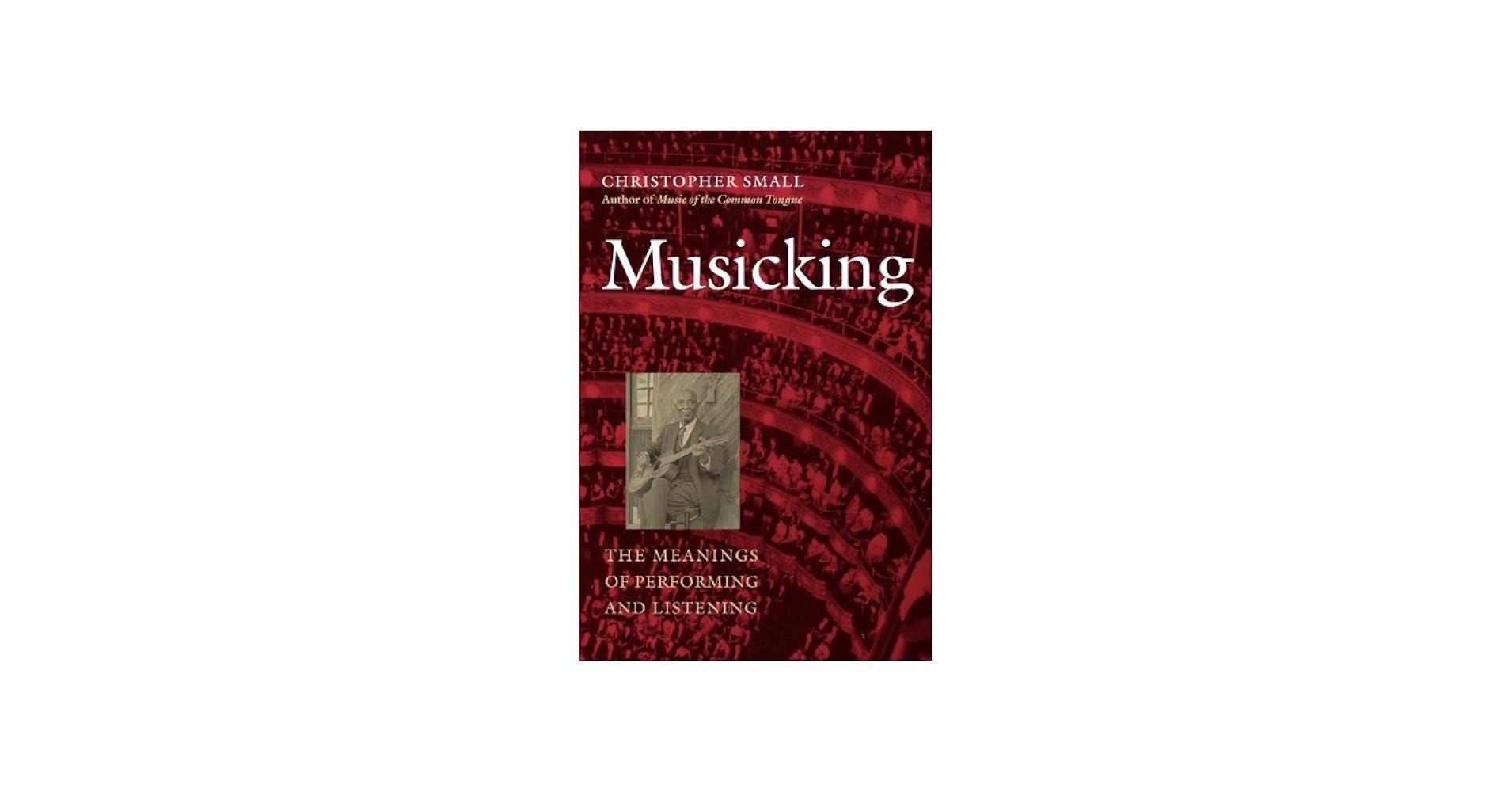
Music is participation in any capacity in and around musical performance, whether by performing, listening, rehearsing, dancing, or working the door. The roadie who tunes the bass. The sound engineer running the board. The guy who upsells the ticket on the secondary market. (Okay, maybe not that guy - fuck that guy). They’re all musicking.
In other words, music doesn’t exist as an object you can hold. It exists in the act of doing it.
Christopher was reacting to the common belief that Beethoven’s Fifth exists somewhere in the ether and we’re all just encountering it in various imperfect forms. But music isn’t a Platonic ideal. It’s the sweat on the stage, the hum in your ears, the tears laying on the rug with a lover listening to Your Hand in Mine.
Music is something you do - not something you have.
State of Flow
My icon, Laurie Spiegel, understood this from a different angle. Laurie worked at Bell Labs building algorithmic composition tools. Her goal wasn’t to replace human creativity with computers, but rather to automate the disruptive parts so she could focus on “inhabiting the state of flow.”
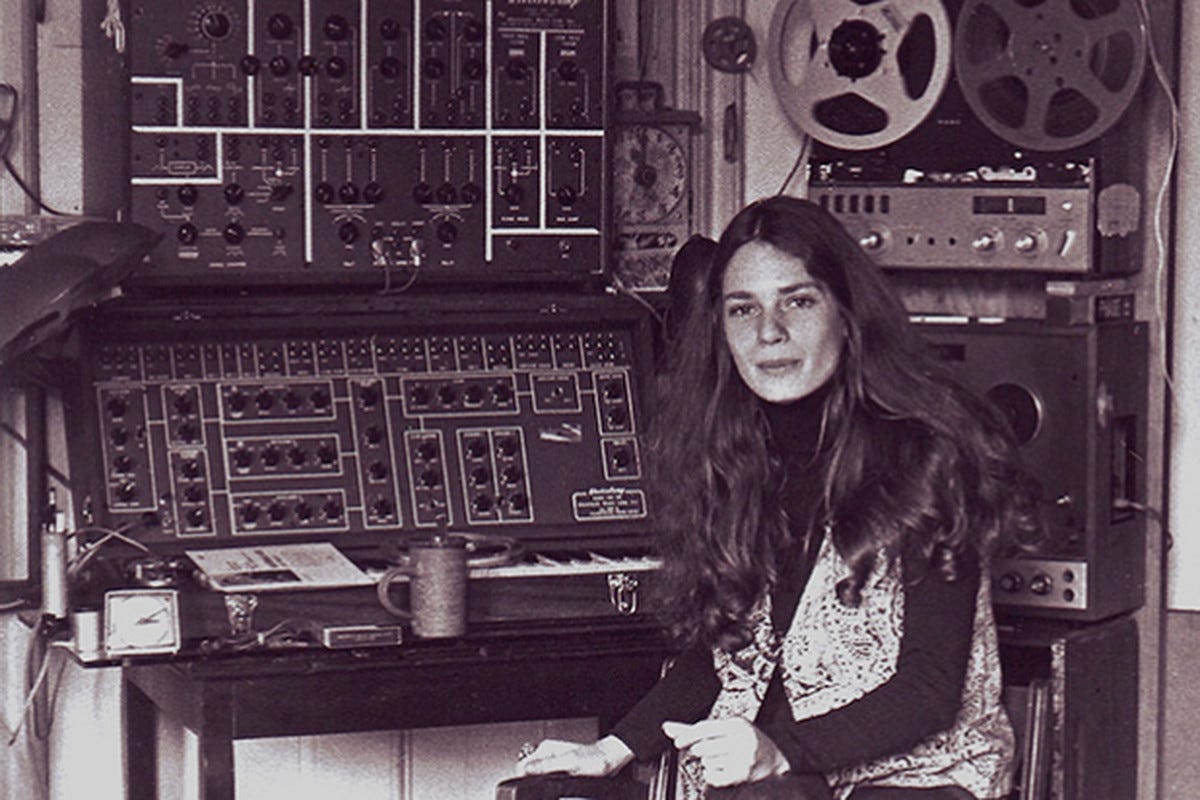
“Music composing often really bogs down at the level of the note … and people lose perspective and they muddle around.”
Spiegel’s software let her work at the level of gesture, of shape, of architecture. She wasn’t interested in perfecting individual notes. She was interested in the process of exploration, discovery; of music itself.
This is process primacy. The beauty is in the doing, not the finishing.
The joy is in the exploration, not the artifact. We live in the age of the finished file, the polished thing you can screenshot and share. But the file doesn’t capture what it felt like to make it. It doesn’t hold the 47 rekt versions you deleted. The process disappears, and all we’re left with is the output.
Laurie wanted to music, not to have music’d or be music’d.
Participation is Mandatory
What Christopher and Laurie (and I) are getting at is that music happens at every point along the Spectrum, not just at the far edge where the “real musicians” live.
But the internet shifted the weight distribution. Pre-internet, most people clustered the right as consumers. You listened to music, wore the merch. The left side was gated by costs and technical knowhow.
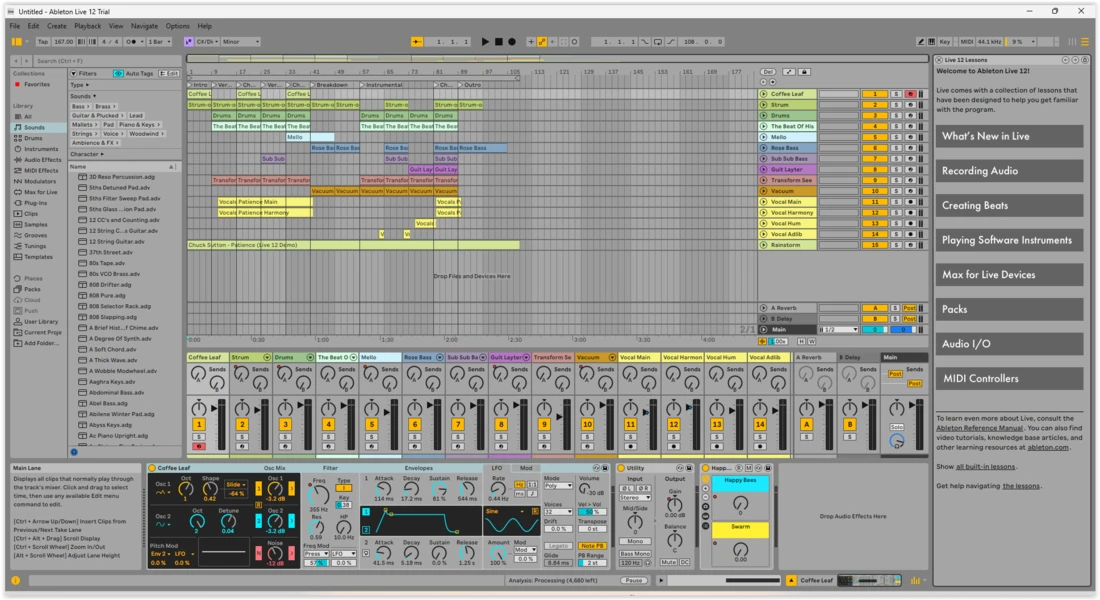
The DAW era shifted that. GarageBand, Logic, Ableton, Fruity Loops. Suddenly anyone with a Dell could make something that sounded halfway legit. Bloghouse era. But you still had to invest the 600 hours to make a snare sound right.
Now we’re in the AI era. Text-to-music generators let you describe a vibe and receive a fully formed track 30 seconds later. No GarageBand. No MIDI controller. No problem!
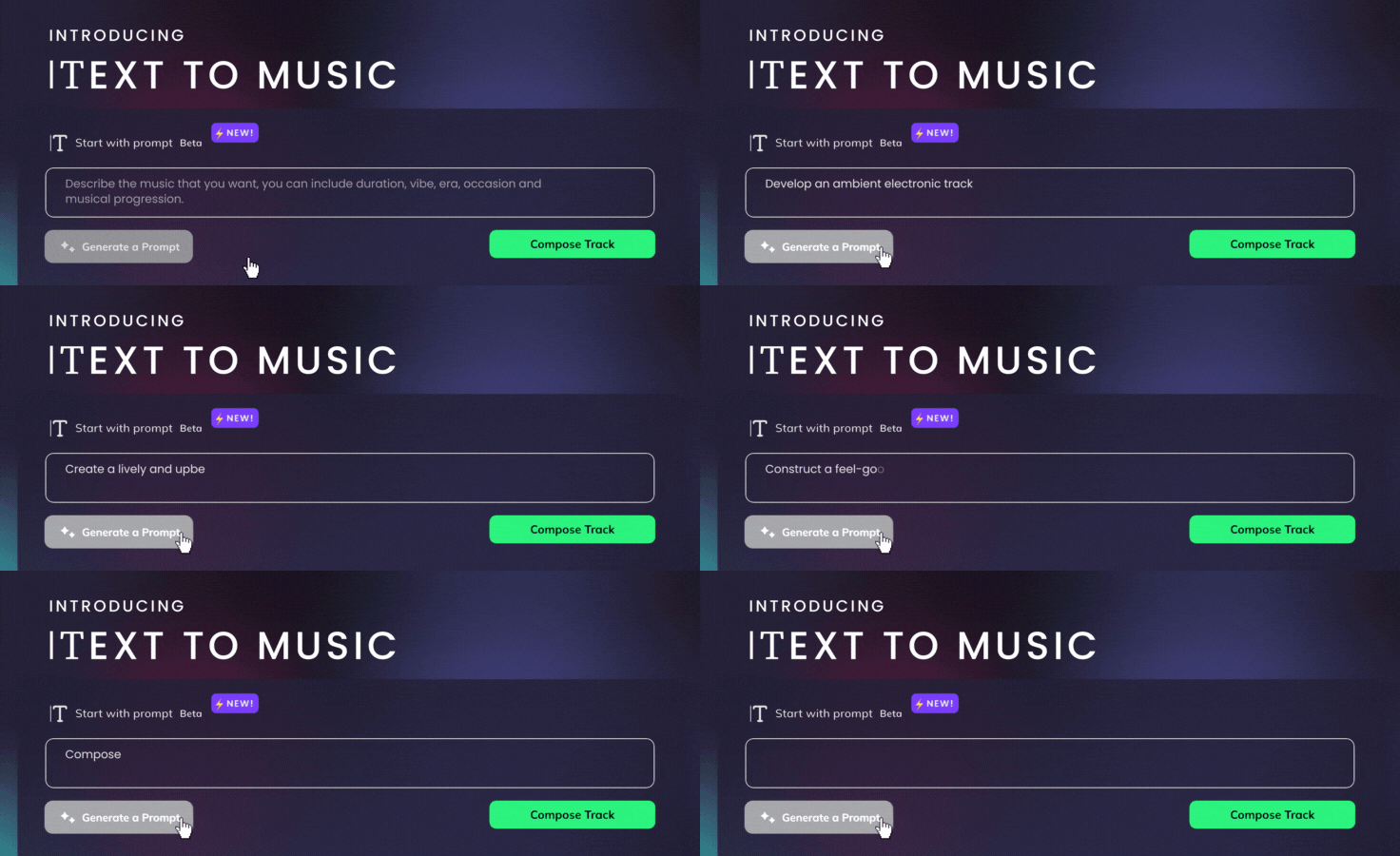
Which brings me back to Laurie. Her whole project was about building tools that extended human creativity, not replaced it. Music Mouse was interactive, not automatic. It required you to stay in the loop, to make decisions, to keep participating.
To flow.
(h/t to my dear friend, Tero, for this, as well).
See, it’s not about where you are on the Spectrum. It’s about whether you’re still inside the process or whether you’ve outsourced it entirely. DJing is compositional, playlisting is thesis-driven, AUX’ing is vulnerable, prompting is… an algorithm.
Once you let the algorithm decide, then you’ve destroyed authorship and stepped outside the act of music.
For most of us, we stay on the Spectrum. We participate. And participation is the only scarce resource left.
This matters more now than ever, because we’re living through a moment where the artifact has become so cheap it’s almost meaningless. Anyone can generate a song. Not everyone can sit with it, hold space for it, make it mean something.
The Musical Self-Expression Spectrum is a reminder that music was never really about the MP3 in the first place.
Alas, I fucking cooked that aux cord.
/m
A heartfelt h/t to my friend-mentor-arch-nemesis, Matt Brown, for the ongoing inspiration in design + musicking.
Loved this!! Would love to hear more about what you mean when you say "playlisting is thesis-driven..." been thinking about where play listing sits in the musical landscape lately, and was surprised to see it be to the left of DJ'ing - totally agree, and well said!!
I LOVED reading this- I especially appreciated the permission to take playlist curation seriously and that it was put on the spectrum with actual musicianing. And I found your writing voice and style so engaging and interesting to read - thank you.
I enjoyed this piece so much I’ve included a link to it (hope that’s ok!) in my weekly newsletter that I curate some reading recommendations in- I’m over at inthewritedirection if you’d like to see it 💕🙏🏻