


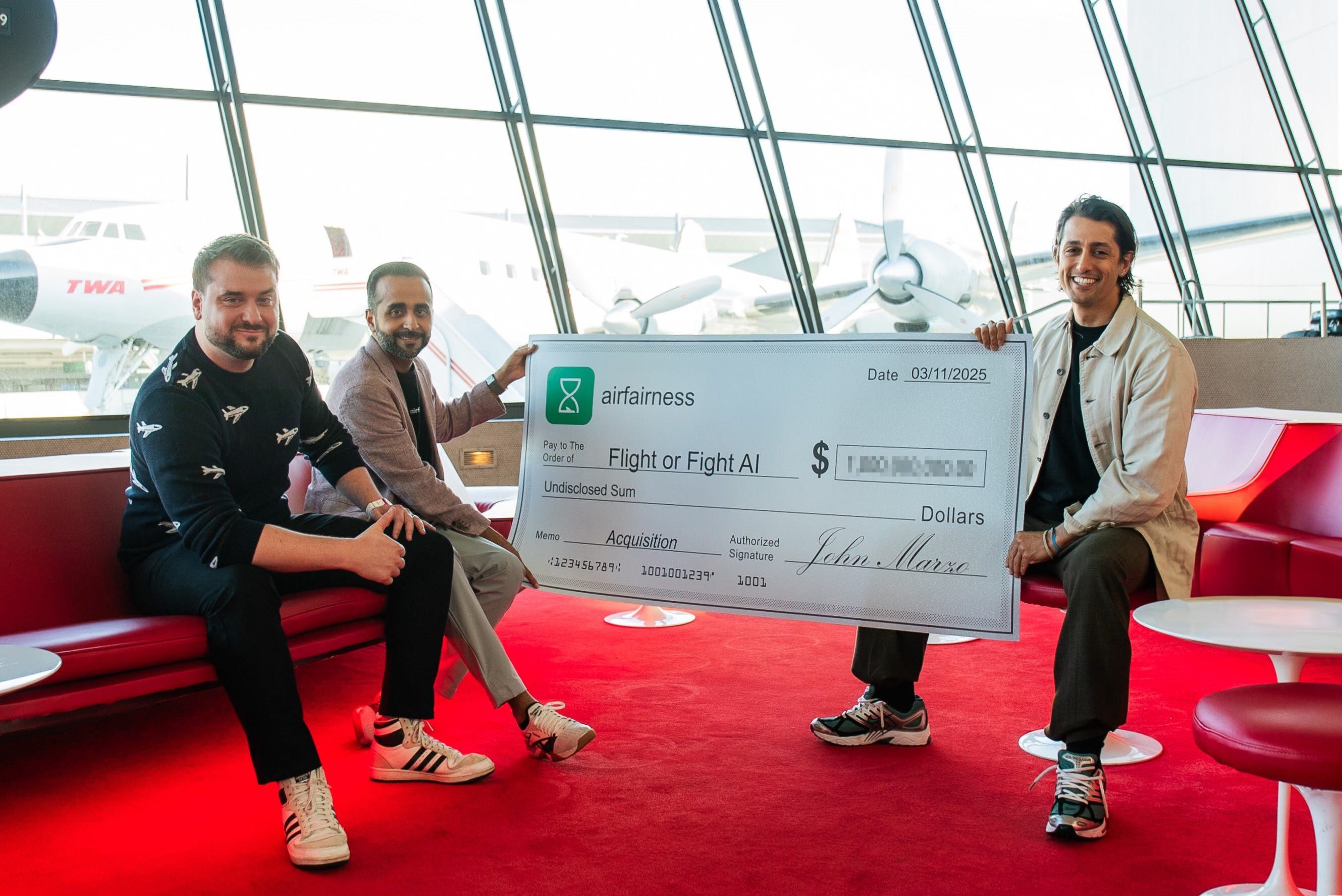
Ram Das famously once said, “If you think you’re enlightened, call Delta’s customer service.”
I might be misquoting, but the reality is that nothing quite exposes the human condition like a delayed flight. And despite all the inner work, airline customer service still brings out my final boss.
That’s why for years I’ve had a running joke (or perhaps a low-grade obsession) with building a website that writes your airline complaint letters for you. One that captures the tone, citations, and righteous indignation with finesse. Of course, that wasn’t meant to be a billion-dollar idea. I’m not even sure it was meant to be a million dollar one. It was a human one. The kind of idea that typically lives in the purgatory between my notes app and action.
And I hadn’t really thought about it for a while. It got buried somewhere under “Build a giant Etch A Sketch” and above “Design a visual ASMR app.” And so it goes.
Then Crowdstrike happened – an outage that crippled airline systems globally. All of a sudden, airports turned into dorms. Twitter turned into a boo-hoo forum. And my running joke started, well, running again.
But it felt different this time. What once felt insurmountable AF all of a sudden felt surmountable AI. With the rise of AI tools and “vibe coding” - a term for prompting large language models (“LLMs”) to code on our behalf - writing software suddenly became as natural as writing a few sentences.
So end of the day Friday, I peered over to my protégé / college intern, Chloe, and just obliterated her weekend plans: “Chloe, let’s rip.”

Three days, a Cursor Pro account, and a couple upper deckies later, FlightOrFight.AI existed. An AI tool that turns your flight delays into legal-ish, emotionally precise-ish, complaint letters. No onboarding flow. No press strategy. No investors. Truly, just vibes.
I posted FlightOrFight.AI on LinkedIn that night.
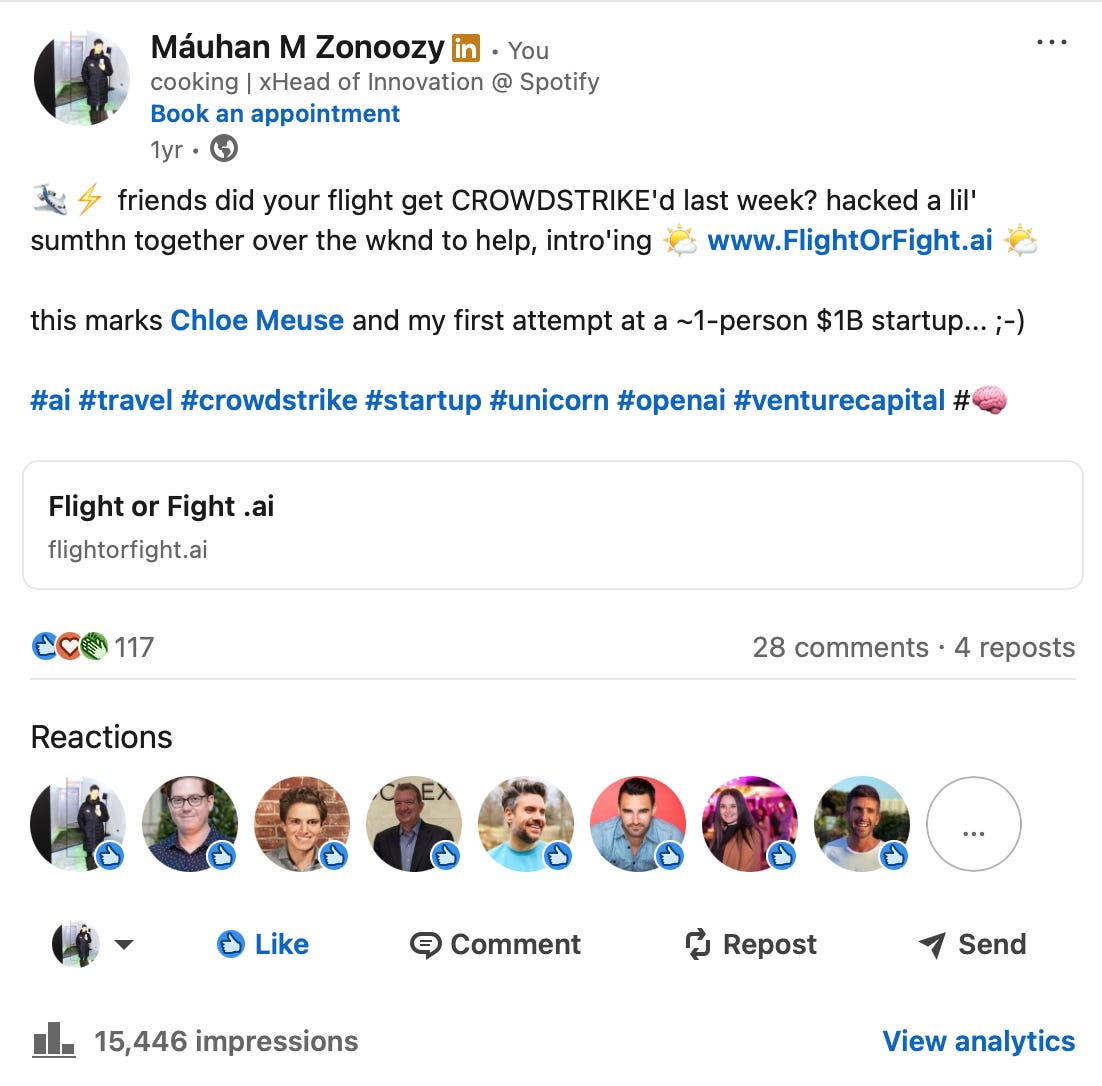
By Monday, it went viral.
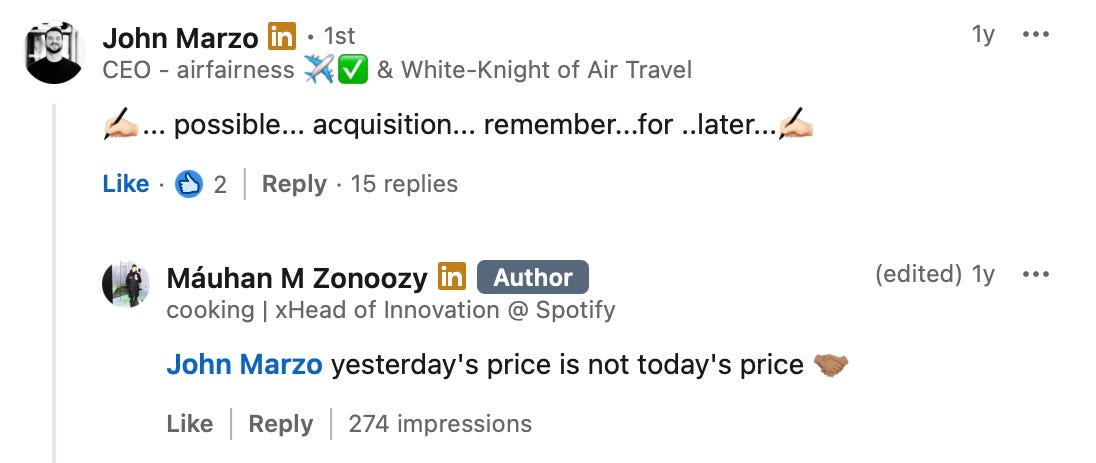
By end-of-week, I had a term sheet for acquisition – literally, negotiated in the comments.
Introducing Cultureware
It took a little over 2 years to sell my first startup. Took a little over 2 days to sell this one.
That’s not to mention the difference in venture funding, full-time engineers, and cortisol levels. So when Sam Altman talks about the lore of the one-person billion dollar startup, I deeply get it. He’s referring to the power of AI to make builders and companies infinitely lighter. Stripping away the noise agentically until even a second employee is considered bloat.
Sounds like a dream, but I’m not entirely sure that’s the way this all shakes out.
That framing is rooted in traditional startup mental models, and old world connotations of products and product-led companies. Building, product-market-fitting, and scaling was the path to IPO. AI makes all of that easier, for sure. It’s what we’ve seen. But it’s not what we’re going to see.
In our new AI world order, monolithic builds won’t be the future of most consumer applications. This revolution will be about tiny apps. Single feature bangers. The idea of an “app” will change to something much more lightweight, and the concept of a “platform” will evolve to something that encompasses the millions (yes, millions) of vibe-coded releases.
(I’ll save it for another essay, but I strongly believe Model Context Protocol (“MCP”, h/t Anthropic) points us in the direction we’re headed).
For now, leveraging AI-assisted tooling has introduced a new tempo of product development. One that feels more like cultural experimentation. Vibe coders and “co-pilots” like Replit, Lovable, and Cursor have turned code into a creative medium - turning a spark of curiosity into running software in minutes. The ability to build while the idea is still fresh – before the world moves on – has become its own creative superpower. It’s not optimization. It’s timing. It’s memes. It’s cultural jazz.
When I posted FlightOrFight, I wasn’t pitching a new company. I was publishing an idea that runs. The idea was solid. (Great, even). Rooted in deep-seeded pain. But upon reflection, it surprisingly wasn’t the idea, the customer service letters, or the “sticking it to the man” energy that stuck with me. It was the feeling that something could move that fast. That an idea could. That I could go from running joke to public release to acquisition in seventy-two hours flat.

That’s not a startup. That’s cultureware.
Code as Content
And cultureware - like memes - may not be built to last - or scale - the way FAANG was. It might be less about crafting perfect 10-track albums, and more about dropping singles.
Because in the end, I didn’t build FlightOrFight like a startup. I built it like a song.
Viewing app development within that framing of creative culture makes it clear that something has fundamentally changed: code has entered the chat.
See, for as long as I’ve dialed up, the creative internet ran on a simple division of labor: companies made code, creators made content. Startups built feeds, consumers consumed ‘em. Boomers made songs, Zoomers made the Turtle Rabbit Dance.
But AI has entirely collapsed the distance between idea and execution - and the boundary between code and content has dissolved more aggressively than we’re giving it credit for.
Apps today are used as a means of distribution, and attention - not necessarily LTV. Thus, it feels inevitable that the cultural loop of content creation will enter the world of app and product development. We will build software the way we post on Instagram. Not code as infrastructure, but code as performance itself. Apps as creative expression.
In other words, code as content.
The feed, not the App Store, will be the distribution channel. And while yesterday’s feeds were filled with thoughts, thots, and thawts - tomorrow’s will feel more interactive. Sora’s remix function hints at this future. “Social vibe coders” (just made that term up) like Gizmo, Rooms, and Spielwerk blatantly point at it. We’re not publishing content in mono anymore. Not even in stereo.
We’re spatial now, bb.
Your App (Hype M Remix)
With this new rhythm of creation – where the tools are fast enough to keep up with the imagination - software will feel less like work and more like play. More like songs. More like memes.
And if apps are songs and memes, it’s clear that remixes and self-referential software is fated. As a Tumblr-era, Hype Machine fanatic, Soundcloud kid, that might be the future I’m most excited for. (Or I may just be doing my best to will it forward). So much so, I already remixed my first app.
A few weeks after FlightOrFight’s acquisition announcement went live, I dropped another project: a mashup generator. A startup had got a little buzz after spending a few months on something similar. Another few apps had spent years (and raised millions in venture funding) to do the same. I wondered if I could design something more playful than what was out there, and vibe code it into reality. So I allocated two sugar-free RedBulls to the cause. Less than a week later, I dropped Remixy.
Even the name was a double-entendre (like guac, entendres cost extra). “Remixy” was a mashup app for “remixing” songs, and it was my “remix” of the Mixy app, aka a “Re-Mixy”.

That’s not meant to be a flex; it’s an illustration of the shift - and where I think techno-creative culture is going.
(Okay, fine - it’s flex-ish).
The New Creative Archetype
If every generation gets the medium it deserves, ours gets code.
With it, we’re witnessing the birth of a new creative archetype – part founder, part artist, part cultural operator. Someone who builds software the way musicians release music: frequently, fearlessly, and in public. Move fast and break things means something different.
But we’re not replacing artistic creativity. We’re elevating it, providing new paintbrushes, and removing latency. The barriers that once separated artists from engineers, or founders from fans, are dissolving. A single person can now build something that feels like a product – not a prototype – over a weekend.
The same way punk turned noise into identity and TikTok turned daily life into performance, our new wave of creators will turn code into cultural matter. Small, executable artifacts that say something – about frustration, joy, curiosity, absurdity – and invite participation.
Every app is a mixtape. Every commit, a lyric. Every launch, a statement.
Ultimately, FlightOrFight wasn’t a traditional business (in the business sense). It was a proof of concept – that software could now move at the speed of culture. That code could be spontaneous, emotional, and alive.
And if that’s true, then the next great artist might not drop albums or games – they’ll drop apps that feel like both.
And, as we all know…
The drop is everything.

/m (founder, 2.5x exits)
PR Newswire: Airfairness Launches AI Flight Compensation Tool After Acquiring Weekend-Built Startup via LinkedIn
The Founders Press: Airfairness Launches AI Flight Compensation Tool After Acquisition of FlightorFight.ai
Yahoo! Finance: Airfairness Launches AI Flight Compensation Tool After Acquiring Weekend-Built Startup via LinkedIn
what a show. need some popcorn for whats next
this story is 🤌🤌